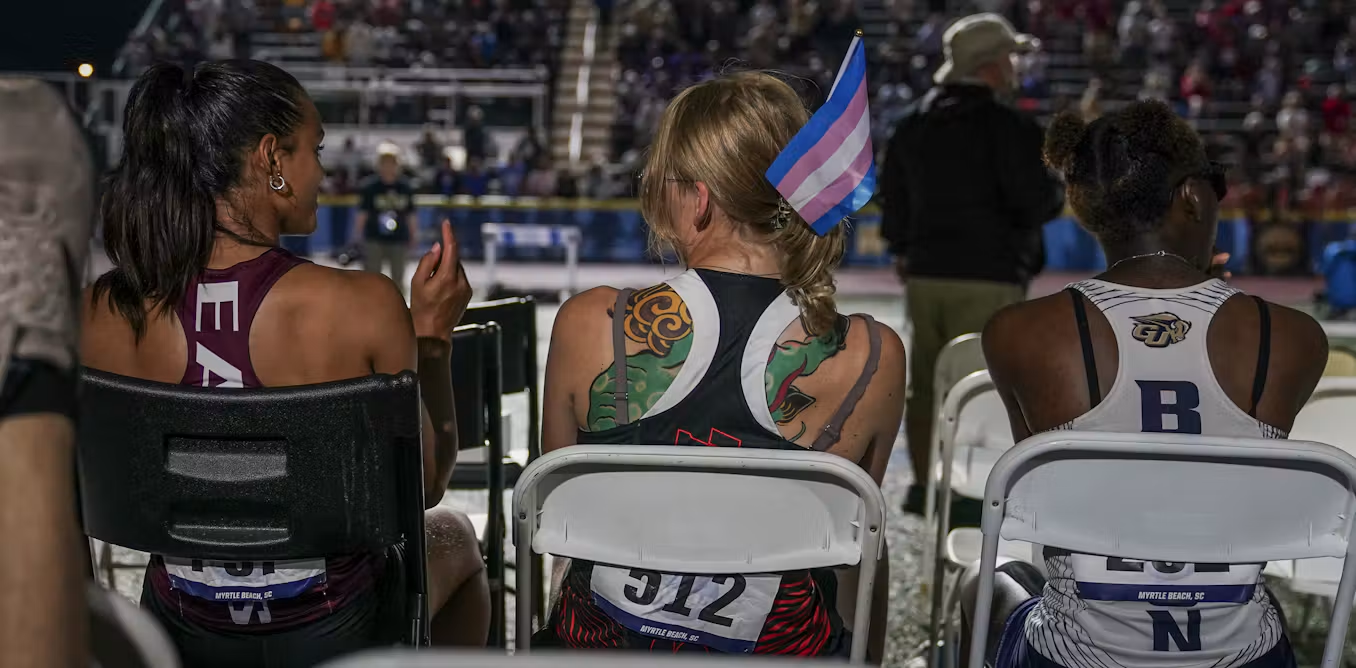
Are transgender sports bans really about protecting women? Survey data tells a different story
Relatively few transgender athletes participate in high school and collegiate sports. Still, since 2020, 27 states have passed laws banning them from participating in sports based on their gender identity.
Just weeks after his second inauguration in 2025, President Donald Trump signed an executive order prohibiting transgender women and girls from participating in women’s sports in K-12 schools, colleges and universities that receive federal funds. Supporters of these bans often argue that they protect women and girls from unfair or unsafe competition. As Trump said at the signing ceremony: “we will not allow men to beat up, injure and cheat our women and our girls.”
WNBA star Sophie Cunningham offered a similar rationale in a July 2026 ESPN profile: “I want to protect young girls in a locker room, or young girls in sport who shouldn’t have to go against biological men.”
These statements suggest that those in favor of bans are motivated by their admiration for female athletes. But are Americans with more positive views of women and women’s sports more likely to oppose transgender women competing in women’s sports?
We are political scientists who study public opinion toward transgender Americans. To understand how attitudes about gender shape Americans’ views on policies that adversely affect the rights of transgender Americans, we asked 1,000 American adults about their support for restricting the participation of transgender athletes in sports. We also asked about their feelings toward women as a group, their endorsement of sexist stereotypes and their attitudes toward policies that promote gender equity, such as Title IX, the law requiring schools that receive federal funding to provide women and girls with equal opportunities to participate in athletics.
Sexism and support for bans
Our survey found significant public opposition to transgender athletes playing on teams that match their gender identity. When asked whether they “support or oppose a bill that prohibits transgender youth from joining school-sponsored sports teams that match their gender identity,” about half of respondents supported the restriction.
But admiration and support for women do not translate into greater support for excluding transgender people. In fact, individuals with the most negative views of women and gender equality are the most likely to support these bans.
Read more How governments worldwide are shaping what AI can say about politics
We asked respondents to rate how they feel about women on a scale from 0 to 100. Researchers have used this tool, known as a feeling thermometer, for decades to measure how Americans feel about different groups, including people of color, gay and lesbian people and members of the opposite political party. Among respondents with the most positive views of women, 45% supported restricting transgender sports participation; among those with the most negative views of women, 58% supported restrictions.
We also tested whether more sexist views predicted support for these bans. To measure sexism, we asked respondents how much they agreed or disagreed with three statements about women: “Women seek to gain power by getting control over men,” “Women are too easily offended” and “Women exaggerate problems they have at work.” Social scientists commonly use these questions to measure “hostile sexism,” a set of stereotypes in which women are portrayed as incapable, manipulative and controlling. Among the least sexist respondents, 28% supported banning transgender people from sports matching their gender identity; among the most sexist, 79% did.
If admiration and support for female athletes drive support for prohibiting transgender women from participating in women’s sports, then those who favor Title IX should also favor bans. Instead, 43% of Title IX supporters favored restrictions, compared with 70% of Title IX opponents.
Our findings – that negative attitudes toward women and opposition to Title IX predict support for banning transgender women from sports that match their gender identity – hold even after accounting for other factors like partisanship, ideology and demographic characteristics.
The protection argument
The debate over transgender athletes is often framed as a matter of protecting women. Our findings complicate that narrative: People with the most negative attitudes toward women – and toward policies that protect women’s sports – are the most supportive of banning transgender women from women’s sports.
That does not mean that everyone who supports a ban is motivated by hostility toward women. But the consistency of these findings makes it difficult to accept that protecting women is a primary reason why Americans support these restrictions.

Related Posts

Maine Sen. Collins’ success bringing home federal funds is a perfect example of the thin line between political favoritism and effective representation

Are partisan politics even changing up our accents? They just might be, y’all